Helping faith communities take action for gender equality

Partner
The mission
World Vision has a 20+ year-old intervention model called Channels of Hope. Through this program, church and faith leaders are motivated and equipped to take action on child well-being issues. Channels of Hope is implemented globally and exists in different versions.
We were brought in to support one version — Channels of Hope Gender (CoH G). Its goal is to improve gender equality, reduce violence, and strengthen violence response.
However, over the years, the program had been expanded, changed, passed hands, and bulked up. In the process, it had lost popularity and implementation fidelity. The program needed a full redesign.
The approach
We engaged closely with stakeholders across positions, religions, and continents (including South America, Middle East, East Africa, and Asia Pacific). We started with a broad understanding of experiences and perspectives, then over multiple rounds, we dove deeper and more specific to the root problems behind CoH G.
The root problems gave us direction to begin adjusting the materials and tools — not just aesthetically, but structurally. We invited our stakeholders to continue brainstorming, co-creating, and providing feedback, especially when we had to make design decisions that would affect how CoH G was perceived and implemented.

The insights
-
What we knew:
CoH Gender is powerful — because it uses an evidence-based methodology that facilitates personal transformation and action towards gender equality.
What we uncovered:
Even though the methodology is embedded in the program, many of the tools and structures are designed to help participants replicate CoH G, rather than to act on community issues.
“If the training is just for training, you just stop in the knowledge. It’s not good impact. We need programs that can solve the problem in the community.”
-
What we knew:
There is a mixed result of effectiveness - sometimes faith leaders take on action to address gender inequality, and sometimes they don’t.
What we uncovered:
Actions that fall within a faith leader’s perceived roles, responsibilities and structures are self-driven and sustainable.
Actions that fall outside of these parameters are treated as WV-owned — it is sustained only as long as WV provides funding.
“They [the faith leaders] took the ownership of it [the action] because they knew they had the resources in the back. One of the questions I have is around sustainability. Would they still be doing if WV wasn’t resourcing them?”
-
What we knew:
CoH Gender is modeled after other successful CoH versions — like CoH HIV/AIDS and CoH Child Protection — where faith leaders attend 3-day workshops, then are motivated to carry out action.
What we uncovered:
In the faith context, gender-related beliefs are much more sticky, sensitive, and contested than the other CoH topics. Addressing gender will take more trust, time, and relationship-building.
“It took me almost a year or so to accept that a male and female are equal. It took me a lot of time because, from the time I was a Christian, I was trained as a pastor, both degree and diploma, went into the church. All this time I have learned, believed and taught that the man, because he is a man, he is a leader of the woman. I have been taught that it’s how God has put it. Give me 3 days to change the view – how is that possible?”
The action
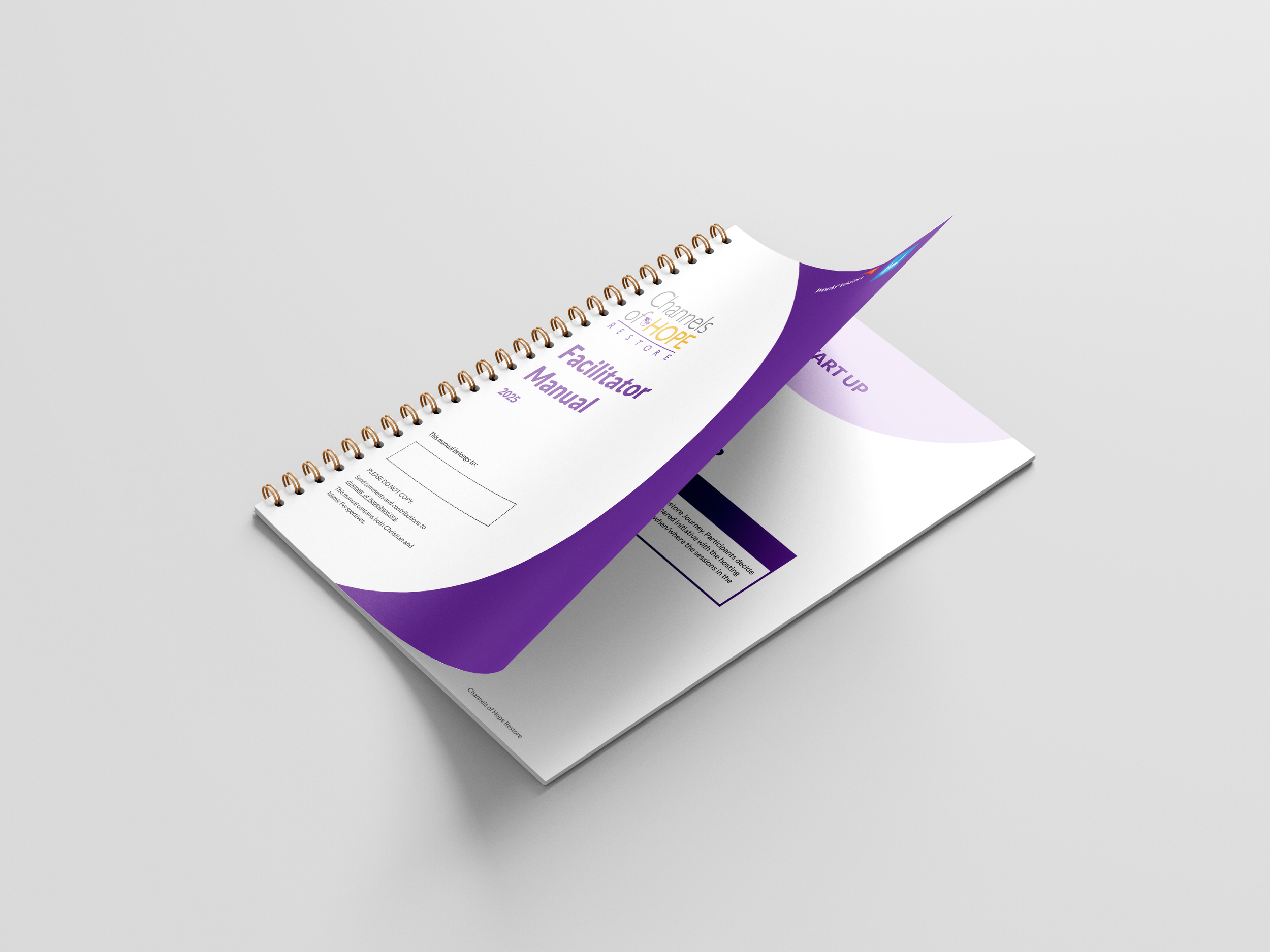
We redesigned the program to make it more action-oriented, user-friendly, modularized, adaptable, and streamlined. This included designing the full set of implementation-ready tools, which were put to use immediately in East Africa and Asia.
We also delivered a breakdown of the significant program changes (including renaming the program to “Channels of Hope Restore”) and the rationale to help with change management.
The insights and structural changes resonated so well with WV’s challenges and vision for their programming that they were taken forward to other CoH Versions and other intervention models.